Show Us Your Pearls In Action!!!

You are 100% right. That is the case: non-nucleated, but tissue "nucleated" (you need the mantle tissue to create the pearl sac). Usually not deliberately created: the oyster must have spat the bead out, but you can also just tissue nucleate an oyster! I did that many, many times.
Was this for the purpose of experimentation? To see what results?
 
This is from CIBJO's Blue Book -

5.106 Keshi cultured pearl
A trade term that designates a non-beaded cultured pearl (5.139) formed accidentally or intentionally by human intervention in marine pearl oysters
Now I guess it must be asked if 5.106 serves as an umbrella over 5.187 and 5.196, and if so, why the latter definitions would be required.
 
Was this for the purpose of experimentation? To see what results?
According to my reading of gem lab 'exposés' at the time, clandestine efforts were made to create pearls that would pass natural certification, perhaps adapting techniques perfected in Chinese FW mussels, and in the process quality greatly improved. As a result, keshi supply, consistency and quality appear to have been enhanced.
 
Ok, so this conversation is whizzing over my head, but I am wearing keshi and I know I love them!! :LOL:

Golden SS keshi strand from Takahashi, and a rope I knotted with SS keshi from a Hong Kong show.
IMG_2833.jpeg

IMG_9784.jpeg
 
On my reading of 5.106 that would preclude anybody using the term "freshwater keshi" as it specifically says "marine pearl oysters". Gee that seems to have gone out the window.

Jeg those golden SS keshi are gorgeous - though I am not sure that they qualify as "poppy seeds"! :)
 
Ok, so this conversation is whizzing over my head, but I am wearing keshi and I know I love them!! :LOL:

Golden SS keshi strand from Takahashi, and a rope I knotted with SS keshi from a Hong Kong show.
It seems we've gone down a rabbit hole, for sure. As Jeremy pointed out, the term 'Keshi' has been convoluted in myriad ways. Primarly what seems apparent is that producers have learned to produce saltwater 'keshi' on demand. And given their superior gem quality, to what extent are white marbles inside our pearls still necessary?
 
On my reading of 5.106 that would preclude anybody using the term "freshwater keshi" as it specifically says "marine pearl oysters". Gee that seems to have gone out the window.

Jeg those golden SS keshi are gorgeous - though I am not sure that they qualify as "poppy seeds"! :)

Your reading is right. Officially the term is restricted to saltwater pearls, which is why we'll sometimes see "keshi-like" used with freshwater pearls. But you're also right that it seems to have gone out the window.

The process can be very similar - a bead is rejected and the sac grows a pearl, or a pearl is harvested and the shell is returned to the water to grow a "keshi" in the existing sac. That happens in both fresh and marine.

I believe the reason for this inconsistency is because there are three pearl industries: natural, bead-cultured saltwater and Chinese freshwater. They are like three different countries with competing priorities who aren't the best of friends.
 
Keshi also refers to saltwater pearls that are without a bead nucleus because the oyster expelled the bead.

When the bead was implanted, a bit of mantle tissue was also implanted-- it is the mantle tissue that forms the pearl sac. If the bead is expelled the sac remains. The pearl farmer may X-ray the oyster, discover there is no bead, and re-implant the oyster with a new bead, but if not, a keshi results.

Here are my Tahitian keshi (I think you saw them when we got together a few years ago):
View attachment 469858

Yes, I remember these gorgeous nuggets. They are breathtaking. Thanks for the explanation-I understand it better now.
 
You are 100% right. That is the case: non-nucleated, but tissue "nucleated" (you need the mantle tissue to create the pearl sac). Usually not deliberately created: the oyster must have spat the bead out, but you can also just tissue nucleate an oyster! I did that many, many times.
Thanks for the explanation. I understand it better now.
 
Pomelo - I love Keshi studs. They generally lay pretty flat and have all that flattish surface to add presence . The little hills and valleys catch the light beautifully.

jeg - Lovely pearls - those sweet little teeny kasha....glad my fat fingers didn't have to string them !!

BWeaves - Ooooo the lustre ! That pendant just glows... and the feather pearls are gorgeous.
 
Was this for the purpose of experimentation? To see what results?
Some pearl oysters had very small "pearl sacs" (mind you: a pearl sac is a sac of mantle epithelial cells, but the "area" of the oyster's gonad where the pearl is grown is also called the same way, so this is what I refer to here) and I could not even insert a 6 mm bead/nucleus in it...the oyster is already there, ready to be operated...so: just tissue is inserted.
It was a way to avoid waste and obtain a keshi.
 
On my reading of 5.106 that would preclude anybody using the term "freshwater keshi" as it specifically says "marine pearl oysters". Gee that seems to have gone out the window.

Jeg those golden SS keshi are gorgeous - though I am not sure that they qualify as "poppy seeds"! :)
I would use "Freshi" for freshwater keshi...but of course, this is quite unnecessary.
 
Some pearl oysters had very small "pearl sacs" (mind you: a pearl sac is a sac of mantle epithelial cells, but the "area" of the oyster's gonad where the pearl is grown is also called the same way, so this is what I refer to here) and I could not even insert a 6 mm bead/nucleus in it...the oyster is already there, ready to be operated...so: just tissue is inserted.
It was a way to avoid waste and obtain a keshi.
Great background! But this would not apply to the much larger P. Maxima and P. Margaritifera.

Edit: Just to add that this would be another point in favor P. Sterna, that keshi from this species remain truly rare.
 
Last edited:
That was a very interesting discussion. I enjoyed reading it.

Today I'm wearing a mishmash of pearls. A blue tahitian pendant that I really only bought because I loved the setting. I don't need any more tahitian pendants but couldn't pass it up.

20240613_120204.jpg
20240613_120251.jpg


Paired that with my baroque blue akoya bracelet.

20240613_120531.jpg


And natural white hanadamas.

20240613_124811.jpg
 
Some pearl oysters had very small "pearl sacs" (mind you: a pearl sac is a sac of mantle epithelial cells, but the "area" of the oyster's gonad where the pearl is grown is also called the same way, so this is what I refer to here) and I could not even insert a 6 mm bead/nucleus in it...the oyster is already there, ready to be operated...so: just tissue is inserted.
It was a way to avoid waste and obtain a keshi.
One more return to keshis. Following the SOC live stream in which I missed a keshi bracelet lot another lot was offered that I stupidly passed on as I had bracelet on the brain. The pearls were beautifully formed. Would it make commercial sense for SOC to increasingly specialize in keshi and decrease dependence on the beads? After all it isn't a mass market product.
 
Today I'm wearing a mishmash of pearls. A blue tahitian pendant that I really only bought because I loved the setting. I don't need any more tahitian pendants but couldn't pass it up.

View attachment 469869

OOOOO, I love the setting, too. I'm a sucker for an interesting bail. It just elevates a pendant from just being a pearl, to being a necklace.

I've been wearing my new Takahashi BBA pendant a lot. White gold, diamonds, and stunning blue akoyas. Today I'm pairing it with white topaz silver hoops and dyed freshwater drops from Kojima. Gee, can you tell the difference in quality between the metals, gems, and pearls?

IMG_3087.jpeg
IMG_3088.jpeg
IMG_3090.jpeg
 
Last edited:
I have a feeling that pendant will be worn frequently - as it deserves to be! It's remarkable.

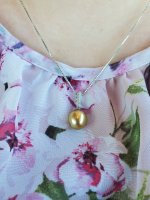
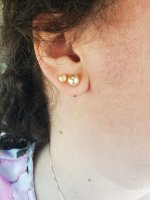
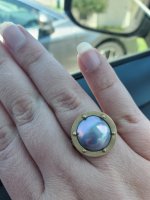
Today I'm wearing the new SoC mabe pearl from the Mexico live event, the new golden pendant from Takahashi's first event, baby 7.5mm light golden SS studs from Ocean's Cove on Etsy, and 5.5mm golden Vietnamese akoya from PP.

20240614_115532.jpg
20240614_121404.jpg
20240614_115909.jpg
20240614_133006.jpg
 

Attachments

  • 20240614_121404.jpg
    20240614_121404.jpg
    2.3 MB · Views: 312
  • 20240614_115909.jpg
    20240614_115909.jpg
    1.5 MB · Views: 283
  • 20240614_115532.jpg
    20240614_115532.jpg
    1.3 MB · Views: 281
Back
Top