Book Review: Renee Newman’s Latest Book: “Pearls. Their History, Sources, Types and Qualities”
The Newest and Most Comprehensive Guide for Pearl Enthusiasts
By Douglas McLaurin
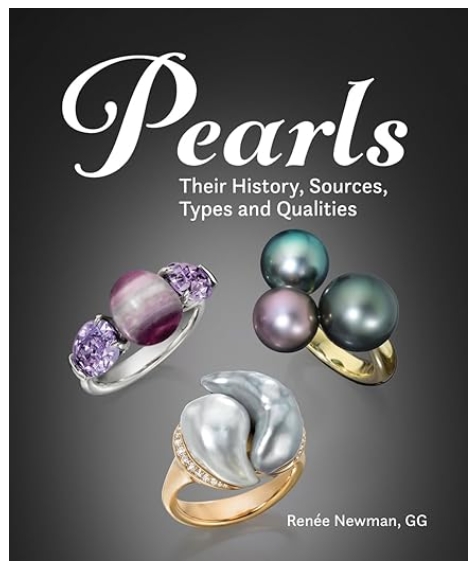
Renee Newman’s latest book on pearls is an exceptional addition to the world of gemology literature. Published just last year, this hardcover volume spans 239 pages and is thoughtfully organized into 13 chapters, each meticulously crafted to guide readers through the various fascinating facets of all pearls: natural, cultured and even imitations.
Newman’s knowledge on the subject shines throughout the book, offering all readers a perfect blend of historical & scientific knowledges and very practical advice. From the history and origins of pearls to detailed insights on the world’s pearl fisheries, cultured-pearl producing countries, as well as pearl grading, selecting, and caring for them, the author provides a well-rounded resource for both novices and professionals. The chapters are structured to build understanding, making complex topics accessible without sacrificing depth.
What makes this book stand out is its clarity and comprehensive coverage and the author makes extensive use of engaging visuals and gorgeous photography to illustrate her points, helping readers appreciate the nuances of pearl varieties, quality, value, and even market trends. The book’s organization allows for easy reference, making it an invaluable tool for jewelers, collectors, and anyone truly interested in pearls.
Each detailed chapter can be used as a stand-alone pearl course, and each feels lovingly written. I will now list each chapter in order of appearance and a couple of highlights:
Chapter 1 – Why are pearls so prized?
We get a very comprehensive review of the pearl producing areas of the world, the time period when these were “discovered” and the historical, cultural and economic importance of these aquatic gems for the local cultures: we read about trading, invasions, wars, as well as religious figures and the nobility that adorned themselves with prized pearls…but the photos… the photos! Absolutely gorgeous images of pearls, portraits and even regional maps that help the reader center on the stories that are woven around the pearls.
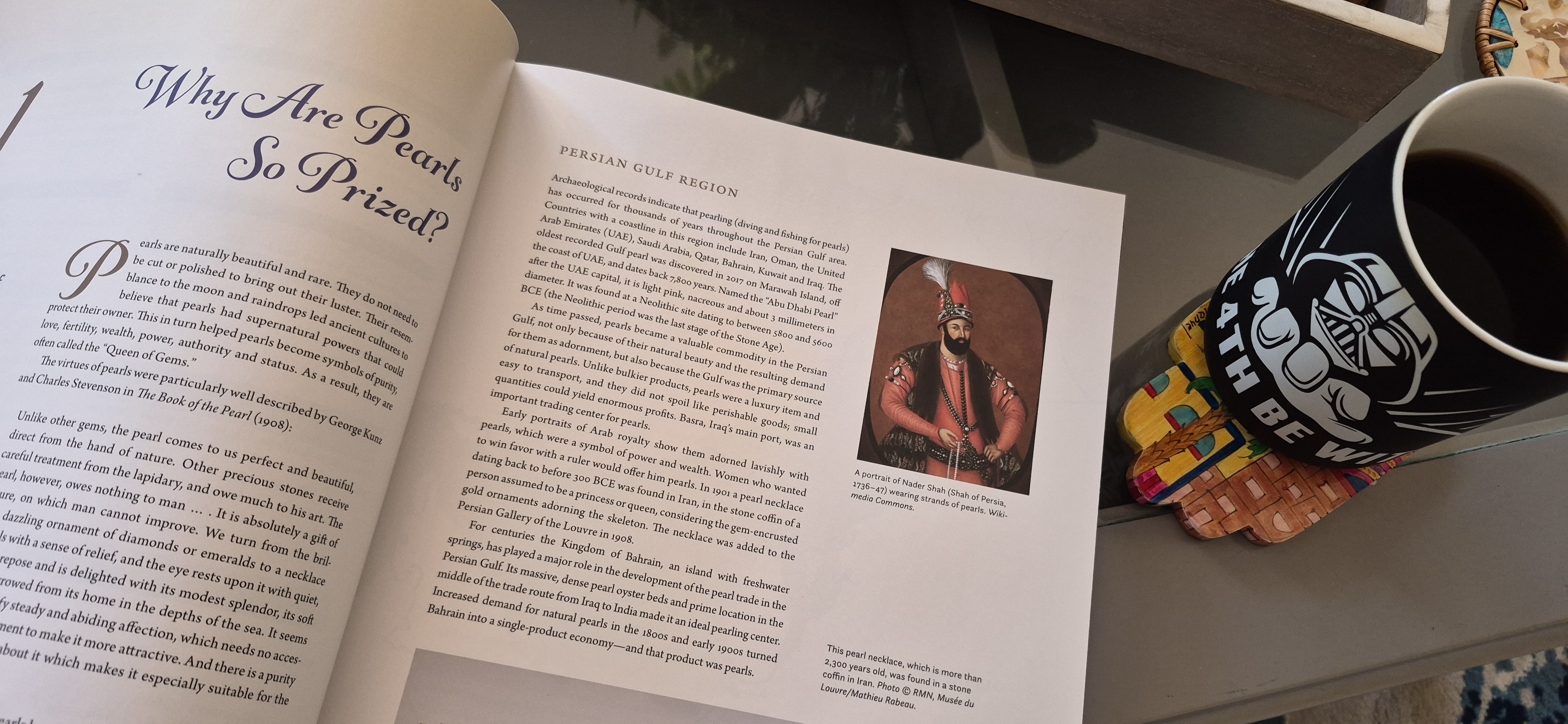
Photo: This is when I started reading the book.
Chapter 2 – Natural vs Cultured Pearls
This section includes a very thorough description of the chemistry and crystallography of pearls, guiding us with detailed diagrams and Electron microscopy samples so we can see how pearls are created by the mollusks and what allows them to look the way they do! Once we have this knowledge we can then move to understand what makes natural pearls different from their farm-raised counterparts. The author goes into complete detail to make us understand all the different ways we can differentiate between these two kinds of pearls.
Chapter 3 – Pearl Value Factors
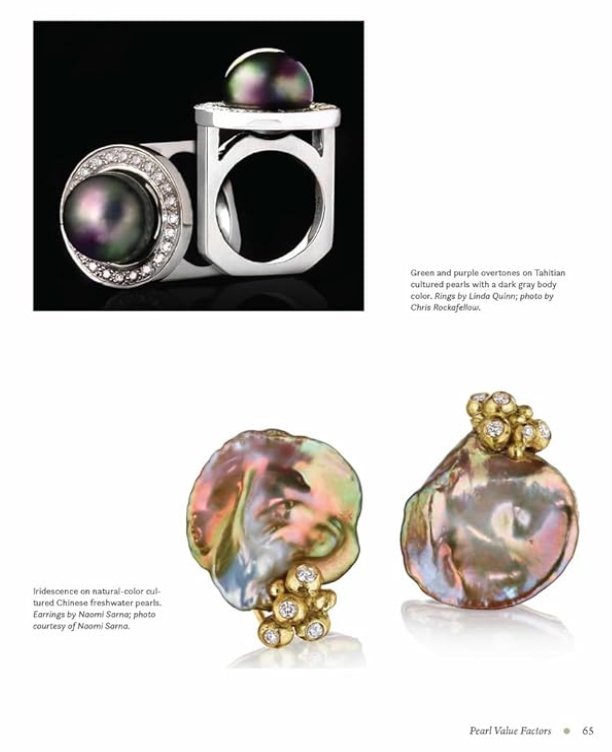
This chapter is always a “must-have” for any pearl book, and it is written with complete intention to detail and comprehensiveness. Over 25 high quality images of pearls, highlighting their luster, nacre thickness, imperfections, coloration, sizes, overtones…I mean everything is there!
Chapter 4 – Akoya Cultured Pearls
“Everything you wanted to know about Akoya pearls but were afraid to be answered in Japanese”: this was the name I was going to give to a book -sans the “Akoya” word- I started writing back in 2000 and that I have never finished. Well, this could have been the name for this chapter that covers everything about the Akoya pearl oyster, the resulting Akoya pearls, the complete story of Kokichi Mikimoto in Japan, but also about other important Akoya pearl producing areas such as China, Vietnam, the UAE, Australia. Quality, colors, shapes, luster, sizes…also covered.
Chapter 5 – South Sea Pearls
Just like the previous chapter but now covering all aspects of South Sea pearl production in Australia, Myanmar, Indonesia and the Philippines. And again…GORGEOUS photography. The part I enjoyed particularly is the “Shape” section where Newmann explains the Round and Near-Round shapes with text, photo and diagrams, and this applies for all shapes…in true and complete detail, but also in a way all readers can finally comprehend.
Chapter 6 – Black Pearls
I really enjoyed this chapter, since this is where my professional expertise truly shines, and Reneé goes all out on explaining the sometimes-confusing term “Black Pearls” by grouping all these different black pearls and then separating them by areas, species and their uniqueness! Once more we are showered with eye-drooling photography, historical facts and quality factors and pricing.
Chapter 7 – Freshwater Pearls
Covering both natural and freshwater pearls from Europe, the United States, Japan and the world’s pearling powerhouse that is China. Chinese freshwater pearls today are a complete world apart from those from the last days of the 20th century when I got to see, touch and buy these pearls for the first time. There are some excellent books about pearls out there…but they have not been updated in decades! Reneé’s book is the PERFECT update and covers most -if not all- of the new varieties of Chinese freshwater pearls. I really enjoyed this chapter and its -once more- gorgeous photographs.
Chapter 8 – Pearls produced by Sea Snails
This chapter also hits close to home due to my love for unusual pearls: Abalone, Conchs, Melos…pearls that have such different origin from those of bivalves! Well, in this chapter we again have stunning photography, detailed species descriptions and complete explanation on the unique traits of each of these pearls.
Chapter 9 – Pearls from Scallops, Clams, Saltwater Mussels and Nautiluses
I have to say the same thing about this chapter as the one before so I will not detail any further, just mention that it covers pearls from different species of bivalves, such as pen shells, clams, quahogs, mussels and…Nautilus? I would have probably placed this species in the previous chapter or not all, but it is here for us to enjoy.
Chapter 10 – Imitation Pearls
This is usually a chapter I care for very little in every single book I’ve read over the last 30+ years of involvement in the field of pearls: not my cup of tea or “not my type of pearl”. Of course, I’ve read plenty about these pearls, but I find the subject not that appealing. But, by means of a couple of stories (that I will not disclose here to avoid the spoilers) I suddenly found myself adoring this chapter!
Chapter 11 – Pearl Processing and Treatments
This is one of the chapters that I believe are always interesting and important to have in any pearl book. Sadly, most do not cover all aspects of the pearl processing nor the treatments done unto pearls. Reason? Trade secrets, undisclosed or even experimental treatments, pearl domination or acts of the “Pearluminatti”? We will probably never know for sure, but this chapter has a very thorough list of processing techniques and treatments that will surely help you understand this subject much better than before.
Chapter 12 – Creating Unique Pearl Jewelry with Colored Gems
Loved this chapter since this is a subject I also worked on for decades, but my jewelry focus was always geared towards the modern and more commercial aspects of jewelry, but I also had a chance to work alongside some amazing jewelry artists and crafters. Now, this chapter was able of giving me a historical insight into the different jewelry design schools of the 19th and 20th centuries, and I was truly not expecting to be educated in such an easy and eye-catching manner: did I mention the gorgeous photography? I believe I have!
Chapter 13 – Style and Care Tips for Pearl Jewelry
This chapter is also a must in every pearl book. It has always been featured in Renee’s previous pearl books. And I just have to say it is very complete, well laid-out and explained. A must read if you are “new to pearls”.
To wrap up the sections: the book also has a good Appendix, Glossary and bibliography.
In summary, Renee Newman’s latest pearl book is a must-have for anyone looking to deepen their knowledge of pearls. Its professional tone, thorough content, beautiful photography and practical approach make it one of the newest and most authoritative guides available today.
Now Available on Amazon.
The Newest and Most Comprehensive Guide for Pearl Enthusiasts
By Douglas McLaurin
Renee Newman’s latest book on pearls is an exceptional addition to the world of gemology literature. Published just last year, this hardcover volume spans 239 pages and is thoughtfully organized into 13 chapters, each meticulously crafted to guide readers through the various fascinating facets of all pearls: natural, cultured and even imitations.
Newman’s knowledge on the subject shines throughout the book, offering all readers a perfect blend of historical & scientific knowledges and very practical advice. From the history and origins of pearls to detailed insights on the world’s pearl fisheries, cultured-pearl producing countries, as well as pearl grading, selecting, and caring for them, the author provides a well-rounded resource for both novices and professionals. The chapters are structured to build understanding, making complex topics accessible without sacrificing depth.
What makes this book stand out is its clarity and comprehensive coverage and the author makes extensive use of engaging visuals and gorgeous photography to illustrate her points, helping readers appreciate the nuances of pearl varieties, quality, value, and even market trends. The book’s organization allows for easy reference, making it an invaluable tool for jewelers, collectors, and anyone truly interested in pearls.
Each detailed chapter can be used as a stand-alone pearl course, and each feels lovingly written. I will now list each chapter in order of appearance and a couple of highlights:
Chapter 1 – Why are pearls so prized?
We get a very comprehensive review of the pearl producing areas of the world, the time period when these were “discovered” and the historical, cultural and economic importance of these aquatic gems for the local cultures: we read about trading, invasions, wars, as well as religious figures and the nobility that adorned themselves with prized pearls…but the photos… the photos! Absolutely gorgeous images of pearls, portraits and even regional maps that help the reader center on the stories that are woven around the pearls.
Photo: This is when I started reading the book.
Chapter 2 – Natural vs Cultured Pearls
This section includes a very thorough description of the chemistry and crystallography of pearls, guiding us with detailed diagrams and Electron microscopy samples so we can see how pearls are created by the mollusks and what allows them to look the way they do! Once we have this knowledge we can then move to understand what makes natural pearls different from their farm-raised counterparts. The author goes into complete detail to make us understand all the different ways we can differentiate between these two kinds of pearls.
Chapter 3 – Pearl Value Factors
This chapter is always a “must-have” for any pearl book, and it is written with complete intention to detail and comprehensiveness. Over 25 high quality images of pearls, highlighting their luster, nacre thickness, imperfections, coloration, sizes, overtones…I mean everything is there!
Chapter 4 – Akoya Cultured Pearls
“Everything you wanted to know about Akoya pearls but were afraid to be answered in Japanese”: this was the name I was going to give to a book -sans the “Akoya” word- I started writing back in 2000 and that I have never finished. Well, this could have been the name for this chapter that covers everything about the Akoya pearl oyster, the resulting Akoya pearls, the complete story of Kokichi Mikimoto in Japan, but also about other important Akoya pearl producing areas such as China, Vietnam, the UAE, Australia. Quality, colors, shapes, luster, sizes…also covered.
Chapter 5 – South Sea Pearls
Just like the previous chapter but now covering all aspects of South Sea pearl production in Australia, Myanmar, Indonesia and the Philippines. And again…GORGEOUS photography. The part I enjoyed particularly is the “Shape” section where Newmann explains the Round and Near-Round shapes with text, photo and diagrams, and this applies for all shapes…in true and complete detail, but also in a way all readers can finally comprehend.
Chapter 6 – Black Pearls
I really enjoyed this chapter, since this is where my professional expertise truly shines, and Reneé goes all out on explaining the sometimes-confusing term “Black Pearls” by grouping all these different black pearls and then separating them by areas, species and their uniqueness! Once more we are showered with eye-drooling photography, historical facts and quality factors and pricing.
Chapter 7 – Freshwater Pearls
Covering both natural and freshwater pearls from Europe, the United States, Japan and the world’s pearling powerhouse that is China. Chinese freshwater pearls today are a complete world apart from those from the last days of the 20th century when I got to see, touch and buy these pearls for the first time. There are some excellent books about pearls out there…but they have not been updated in decades! Reneé’s book is the PERFECT update and covers most -if not all- of the new varieties of Chinese freshwater pearls. I really enjoyed this chapter and its -once more- gorgeous photographs.
Chapter 8 – Pearls produced by Sea Snails
This chapter also hits close to home due to my love for unusual pearls: Abalone, Conchs, Melos…pearls that have such different origin from those of bivalves! Well, in this chapter we again have stunning photography, detailed species descriptions and complete explanation on the unique traits of each of these pearls.
Chapter 9 – Pearls from Scallops, Clams, Saltwater Mussels and Nautiluses
I have to say the same thing about this chapter as the one before so I will not detail any further, just mention that it covers pearls from different species of bivalves, such as pen shells, clams, quahogs, mussels and…Nautilus? I would have probably placed this species in the previous chapter or not all, but it is here for us to enjoy.
Chapter 10 – Imitation Pearls
This is usually a chapter I care for very little in every single book I’ve read over the last 30+ years of involvement in the field of pearls: not my cup of tea or “not my type of pearl”. Of course, I’ve read plenty about these pearls, but I find the subject not that appealing. But, by means of a couple of stories (that I will not disclose here to avoid the spoilers) I suddenly found myself adoring this chapter!
Chapter 11 – Pearl Processing and Treatments
This is one of the chapters that I believe are always interesting and important to have in any pearl book. Sadly, most do not cover all aspects of the pearl processing nor the treatments done unto pearls. Reason? Trade secrets, undisclosed or even experimental treatments, pearl domination or acts of the “Pearluminatti”? We will probably never know for sure, but this chapter has a very thorough list of processing techniques and treatments that will surely help you understand this subject much better than before.
Chapter 12 – Creating Unique Pearl Jewelry with Colored Gems
Loved this chapter since this is a subject I also worked on for decades, but my jewelry focus was always geared towards the modern and more commercial aspects of jewelry, but I also had a chance to work alongside some amazing jewelry artists and crafters. Now, this chapter was able of giving me a historical insight into the different jewelry design schools of the 19th and 20th centuries, and I was truly not expecting to be educated in such an easy and eye-catching manner: did I mention the gorgeous photography? I believe I have!
Chapter 13 – Style and Care Tips for Pearl Jewelry
This chapter is also a must in every pearl book. It has always been featured in Renee’s previous pearl books. And I just have to say it is very complete, well laid-out and explained. A must read if you are “new to pearls”.
To wrap up the sections: the book also has a good Appendix, Glossary and bibliography.
In summary, Renee Newman’s latest pearl book is a must-have for anyone looking to deepen their knowledge of pearls. Its professional tone, thorough content, beautiful photography and practical approach make it one of the newest and most authoritative guides available today.
Now Available on Amazon.