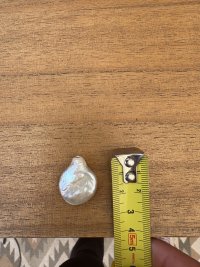
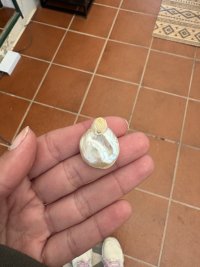
This is an interesting situation. Firstly, finding a natural pearl outside of it's parent shell is a near impossibility, no less one in lustrous condition.
That said, I'll never say never.
To correctly identify pearl origin and debunk fakes, I use traditional data and experience to weigh the scenarios which puts an object in it's place.
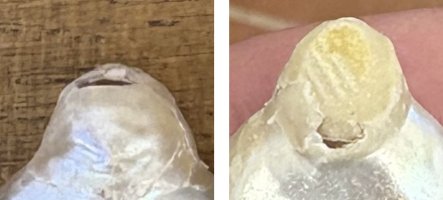
You object presents as a coin shape, but with an attachment at the outer circumference. The attachment was either broken or cleaved and is not available for examination. There are striations at the level of the cut, possibly indicating tooling.
The greatest red flag is surface condition and cleanliness. Any pearl liberated from it's host would almost immediately start to become weathered in the marine environment. Even the most gentle wave action would certainly cause abrasion between itself and the surround basalt. Cracks or grooves would be filled dirt, algae or other sediments and appear dirty in the fringes.
Again, I'll never say never, but without more analysis there are more cursory points scoring cultural origin than natural, irrespective of how it came to be found. "Seeding" of beaches with colored rocks or other gemstones is not an uncommon practice and plausible in this scenario.
If it is natural it's a really long shot, but could fetch good value if certified as such. That leaves us with the burning question whether it merits a trip to the lab. If it's value you seek, then yes, but expect some sticker shock and prepare for disappointment all the same.
It is possible with bright pinpoint lightning you may be able to candle visualize a flat geometric flat nucleus within the object.