Freshwater or saltwater pearls?

suresh vishh

Member
Joined
Feb 21, 2026
Messages
5
I have this necklas for a long time.this is bought from sri lanka.can you help me to identify wether this saltwatee or freshwater? Since the images are not clear i uploaded to my drive and i did put the link below.
Is there anyone can find me this thing?

1000222756.jpg
1000222755.jpg
1000222757.jpg


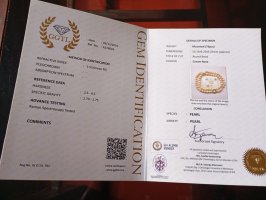
Thank you all for your expert knowledge.i recievd this necklas from a lady which comes from a rich family line. Related to sri lanka's ancient kings. According to her this was with his family since 1960s.so i checked this from a local gem testing lab.
But unfortunately there is no facility to test pearls here in sri lanka.but they have done some tests. I will upload that test reports FYI.
Its really appriciate if you guys could take a look at these and give your guess.thanks.

1000222780.jpg
 

Attachments

  • IMG-20260130-WA0014(1).jpg
    IMG-20260130-WA0014(1).jpg
    107.8 KB · Views: 24
Last edited:
It's a strand if inexpensive Chinese freshwater pearls, probably no more than 10 or 20 years old. It's really only worth a few dollars. It's not at all what she described to you, unfortunately.

This is something we can all tell visually, and your Raman spectroscopy report confirmed it. You see the polyenic pigments showing up as peaks. That is freshwater.
 
It's a strand if inexpensive Chinese freshwater pearls, probably no more than 10 or 20 years old. It's really only worth a few dollars. It's not at all what she described to you, unfortunately.

This is something we can all tell visually, and your Raman spectroscopy report confirmed it. You see the polyenic pigments showing up as peaks. That is freshwater.
Are you sure about that?
Actually i was planinng to go to Baharain to get the DANAT CERTIFICATE for this.
Because i wanted to know the truth about this. So, before that, i think now i have an idea about this as i can see in the comment section.its not worth to going there then.
Thank you very much.To All.
 
Are you sure about that?
Actually i was planinng to go to Baharain to get the DANAT CERTIFICATE for this.
Because i wanted to know the truth about this. So, before that, i think now i have an idea about this as i can see in the comment section.its not worth to going there then.
Thank you very much.To All.
Jeremy is the owner of Pearl Paradise and have decades of pearl experience. If he says something, he is sure :-)
 
Jeremy is the owner of Pearl Paradise and have decades of pearl experience. If he says something, he is sure :-)
Dear load! Is he?.
I didn't know about that and i know nothing about pearls now i can realize.and thank you Jeremy.thank you KarinK thanks to All.you guys saved me a lot.
I would like to say that, this forum is really worth to anybody who interest about pearls.

These guys are well expierenced and I appriciate your valuble comments.
 
Dear load! Is he?.
I didn't know about that and i know nothing about pearls now i can realize.and thank you Jeremy.thank you KarinK thanks to All.you guys saved me a lot.
I would like to say that, this forum is really worth to anybody who interest about pearls.

These guys are well expierenced and I appriciate your valuble comments.
Jeremy is also the president of The Pearl Association of America.
 
They appear to be cultured freshwater pearls from China.
Thanks,
But the doubt is, as you can see on the report I got from the GGTL(Well known Gem testing lab in sri labka),

it says "SPECIES and VARIETY" They mentioned as pearl.I Contacted them again and asked what is that even mean.

They said(Alumini Member,the one who signed the report) they dont have sufficient technology to confirm this is SP. But if they are Cultured, Then they mentioned these parameters as "CULTURED".
But also they couldnt mentioned in the report this is SP. Because they dont have enough tech.
But they tell surely, this is not a cultured.
 
Older cultured freshwater pearls don't have a bead nucleus. They are 100% pearl nacre, just like natural pearls. They are cultured, but were sometimes sold by unscrupulous sellers to unsuspecting buyers as natural pearls. Because the gem labs hadn't seen these types of pearls before, they were given natural certifications. The gem labs only got suspicious when a flood of new "natural pearls" appeared on the market, and the gem labs came up with better tests to tell what kind of pearls they really were. If you really feel these are naturals, then send them to a well known pearl lab that does have the equipment to analyze the pearls to your satisfaction.
 
Back
Top