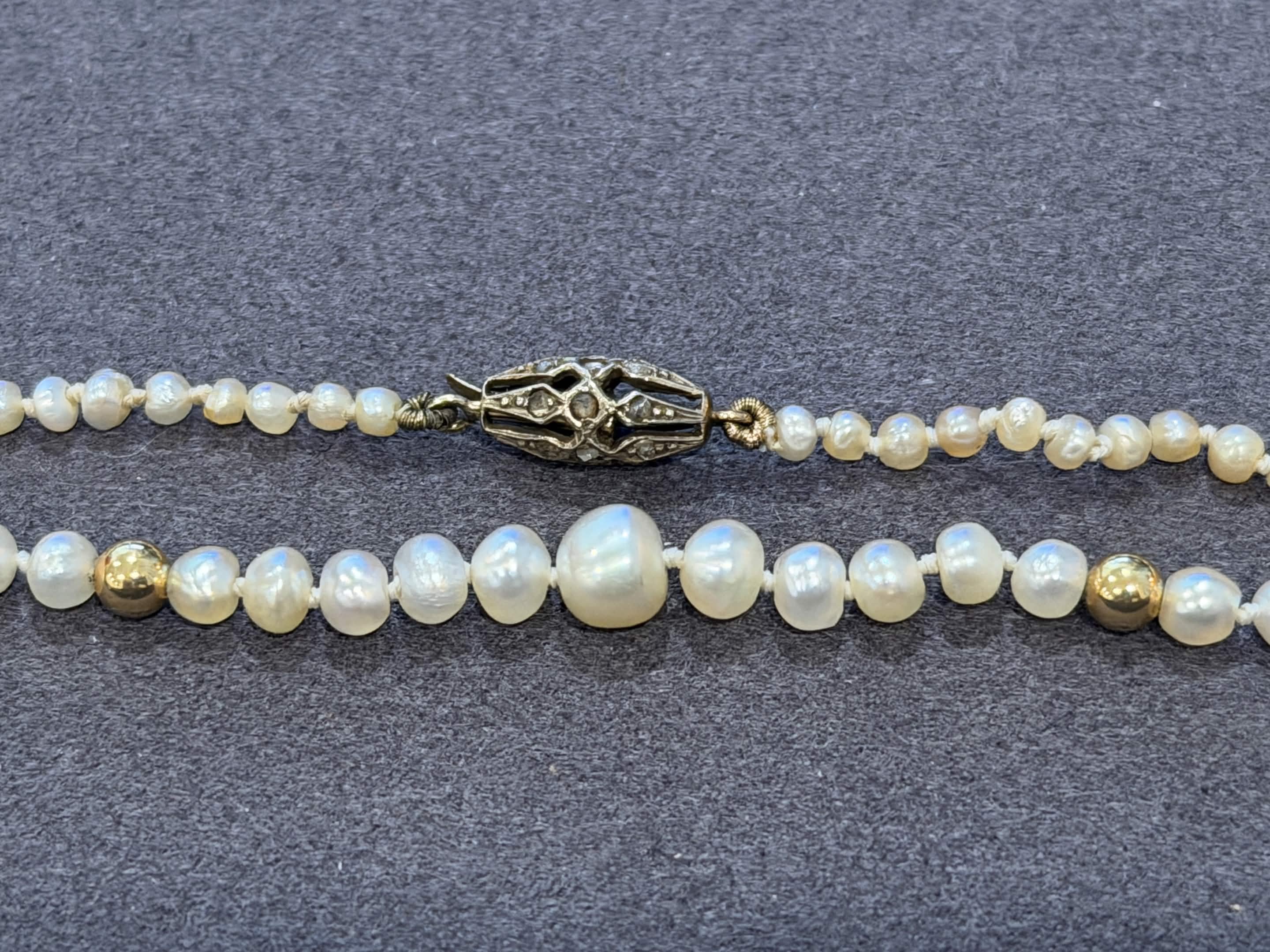
Natural pearls?

Sneeby

Member
Joined
Nov 15, 2026
Messages
4
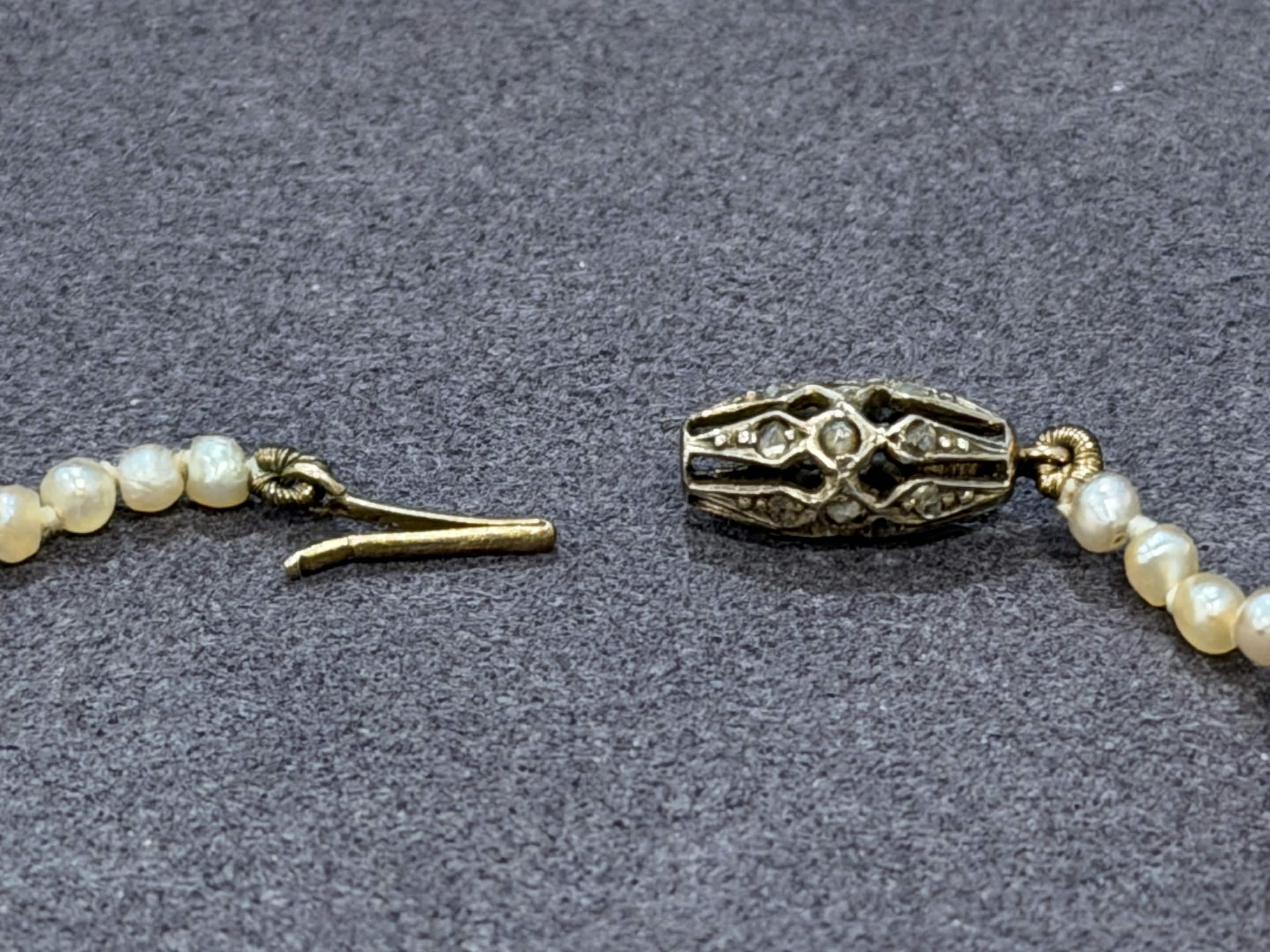
I found this in an old bin of pearls that'd been sitting around for years, and it has me excited! I've never seen a clasp like this. 18k gold with little rose cut diamonds. The camera doesn't pick it up, but it sparkles nicely! It certainly looks earlier than 20th century! What are the chances that these are natural pearls? and how rare is something like this? largest pearl in the center is 6mm.

The good people of reddit directed me here after I posted there.

IMG_4110.jpg
IMG_4104.jpg
IMG_4107.jpg
IMG_4106.jpg
 
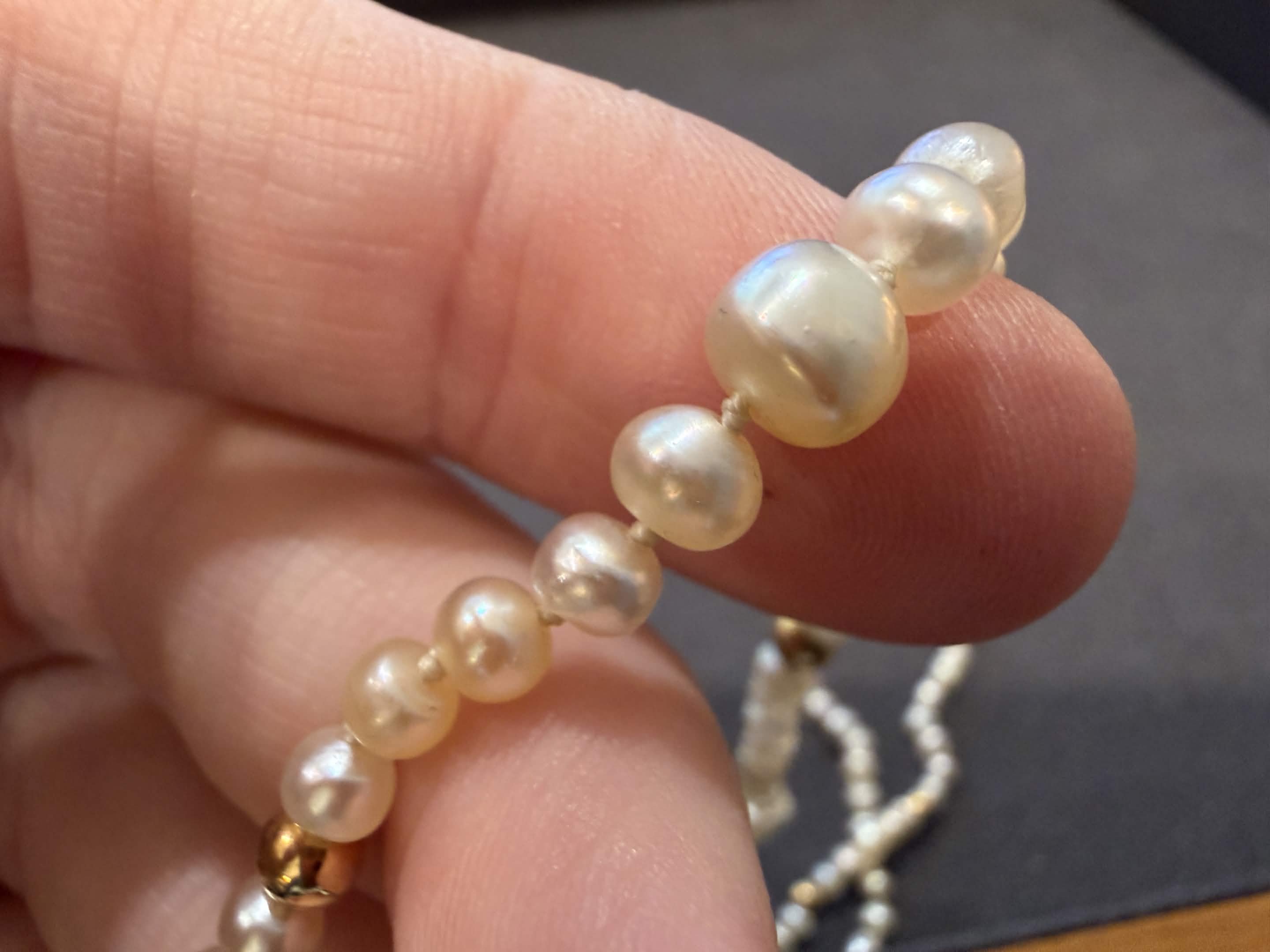
They’re damn beautiful whatever they are. I’m one of the less knowledgeable people here but they look like good candidates for candling. Also maybe test the gold content of those beads? Solid, high karat gold would be interesting, however I’ve also seen naturals with low value items on the same strand so it’s not a huge ton of help.
In all honesty I would kill for a strand like these, even if they don’t turn out to be naturals do not be dissuaded, this “style” of pearl is pretty unmatched in my opinion (and unfortunately uncommon these days in my experience.)
The beads are somewhere between 18k and 22k! I think they're super pretty, too! Tempted to just wear them.
 
The beads are somewhere between 18k and 22k! I think they're super pretty, too! Tempted to just wear them.
But please restring them before wearing them. Old silk is weakened silk and if the thread breaks, the necklace could be lost.
See my tutorial for how to restring them yourself-- many of us do it, and it isn't hard.

 
Yes, it does look like a strand of naturals to me.
I agree. These score high for further investigation.
Oh awesome! Could you give me any insight on what I should do with them?
To start, I would like to examine a new array of photographs. Some close using macro settings and some full frame that I may count pieces and accurately author the descriptions. This usually entails type of species, location of origin, technical differential and recommendations.

These being in the hand of the OP are terrific candidates for candling. I usually prescribe candling that I may comment on the differences or non-differences in uniformity of the signatures in the views. In this case not so critical because I am leaning natural anyway, but I want to see this nonetheless. If you have time, each pearl... full frame. Yes, it's a big task.

Without even beginning to describe, three things jumped out at me that I expect to see when determining natural origin. First, luster. That baby fine surface quality that's rarely mistaken in other sources. Second, the buttery complex with elegant passage of light at depth. And third the shape. It's very consistent with limited pool strands. However, this third observation is very often the method for basing elaborate fakes. I'm not suggesting this in this instance, only that it's a necessary step. I really try to avoid getting hopes high, that can be down-heartening.

A few experts have weighed in on this find with positive views, likewise you seem determined to investigate with interest. If right from the start and you can afford to do so, sending this to the lab would undoubtedly earn the consensus. However, in the abundance of caution and to satisfy some critical steps... you have our attention, let's see more!

Is there anything in family or cultural provenance you can help us with?

 
When I say every pearl, I should suggest the larger pearls instead. All of the smallest pearls would appear the same., but even though they are drilled, I would like to see what remains of the nucleus.
 
I agree. These score high for further investigation.

To start, I would like to examine a new array of photographs. Some close using macro settings and some full frame that I may count pieces and accurately author the descriptions. This usually entails type of species, location of origin, technical differential and recommendations.

These being in the hand of the OP are terrific candidates for candling. I usually prescribe candling that I may comment on the differences or non-differences in uniformity of the signatures in the views. In this case not so critical because I am leaning natural anyway, but I want to see this nonetheless. If you have time, each pearl... full frame. Yes, it's a big task.

Without even beginning to describe, three things jumped out at me that I expect to see when determining natural origin. First, luster. That baby fine surface quality that's rarely mistaken in other sources. Second, the buttery complex with elegant passage of light at depth. And third the shape. It's very consistent with limited pool strands. However, this third observation is very often the method for basing elaborate fakes. I'm not suggesting this in this instance, only that it's a necessary step. I really try to avoid getting hopes high, that can be down-heartening.

A few experts have weighed in on this find with positive views, likewise you seem determined to investigate with interest. If right from the start and you can afford to do so, sending this to the lab would undoubtedly earn the consensus. However, in the abundance of caution and to satisfy some critical steps... you have our attention, let's see more!

Is there anything in family or cultural provenance you can help us with?
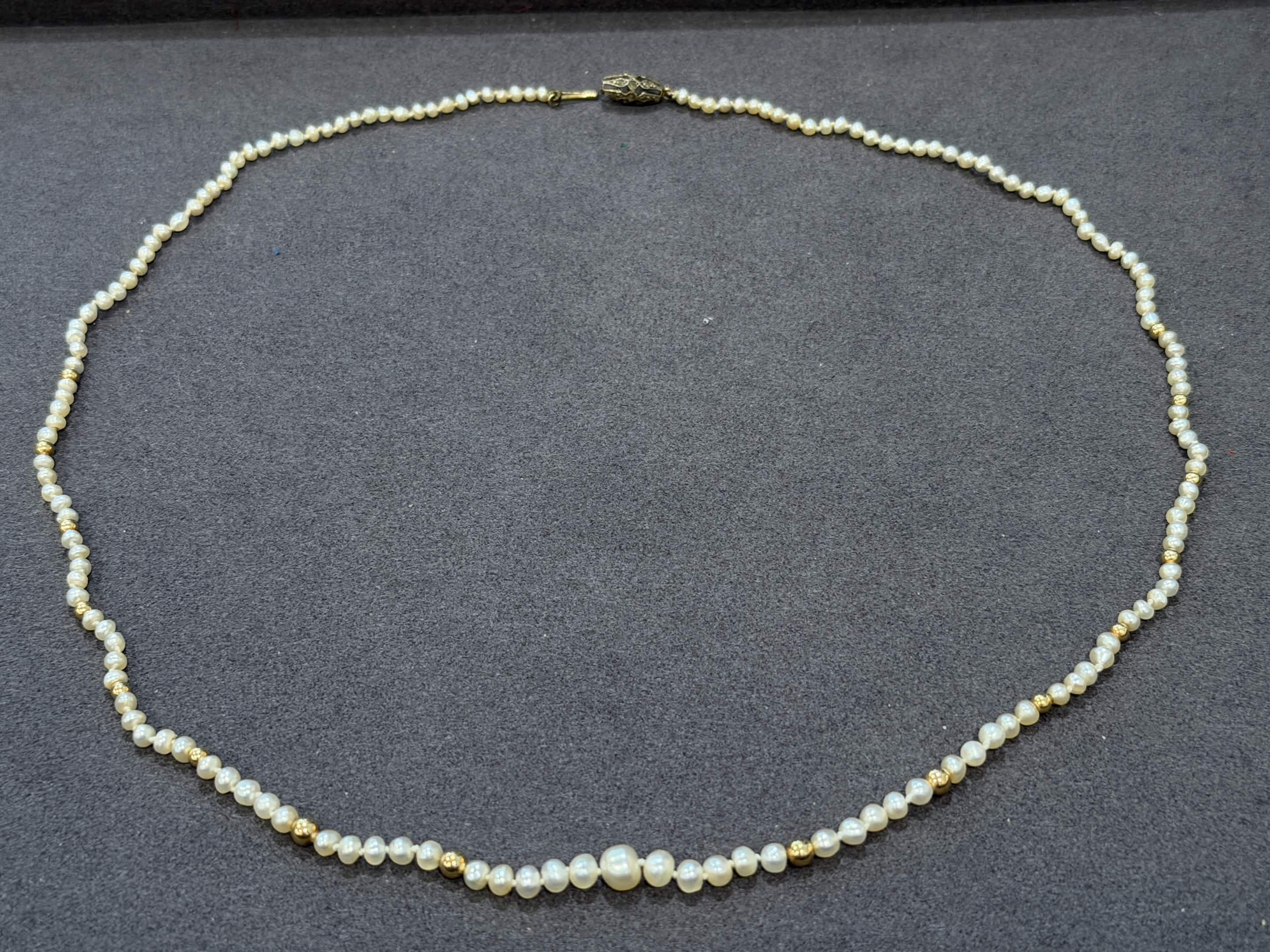
Thank you so much for the in-depth response! It means so much that you're taking the time to look closely. I can photograph through a microscope if you'd like! Unfortunately I can't provide any background info. I used to work for an estate jewelry buyer, so that's how I ended up with these. I'd kill for them to be able to talk!
 
Thank you so much for the in-depth response! It means so much that you're taking the time to look closely. I can photograph through a microscope if you'd like! Unfortunately I can't provide any background info. I used to work for an estate jewelry buyer, so that's how I ended up with these. I'd kill for them to be able to talk!
We see natural strands sometimes, but not commonly. Even then after the discussion many are usually deemed cultural.

A microscope and a good eye are great tools. In almost every case and it's true here, restringing will always be your first good advice. Wash and patted with mild soap and tepid, even cool water.

If you look at the views of natural pearls that have been candled, you will see the signatures to be different from one another. Some large and dark, some small and off center. Some have no visible nucleus at all. In cultured pearls, these signatures tend to appear the same, or at least closely resemble one another by the same description. Some times it's difficult with drilled holes, but a microscope will show something.

These are drilled on Z, which is doesn't support origin (per se), but naturals are often drilled on Y to produce a longer strand, hence a factor for discussion. A high incidence of flat spots tend to favour Z axis drilling so they appear balanced in any rotation.

I mentioned small pool selection. I always consider this. The question I ask myself being - What did they have to work with when selecting the parts for this piece? A well matched strand of say.. 100 pearls would have to be selected from a pool of a thousand, perhaps tens of thousands of pearls. Not just anyone (including me) can produce these on demand without some kind of networking. Graduation is always an cursory sign of a limited selection, because it's easily measured from a distance. Once shapes are out of bounds, color compromises happen. They''' fit size and shape, but the colour not so much. That's actually a good thing, because that's where compromises occur. I like the luster but these are a little more metallic than my first impressions of butter. Once a few more details are brought to light, I'll score those in my report.

Strands like these are very often two pools. One for the big, one for the small. The larger pearls are arranged to the optimal radius then the remaining length strung with matched seed pearls to complete the circumference. That sometimes makes for mixed strands. It's not rare to have seed pearl strands with one or more naturals at the center. Or even a larger number of naturals with enough seed pearls to create a complete piece.
 
I'd kill for them to be able to talk!
“If only they could talk, they might not shut up… but then again, they’d probably talk forever.”

I'll show myself out.
 
Back
Top