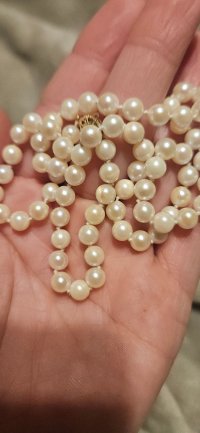
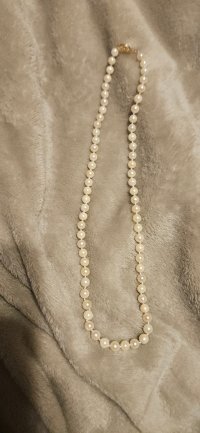
Please identify both!

MamaBear17

New Member
Joined
Feb 5, 2026
Messages
2
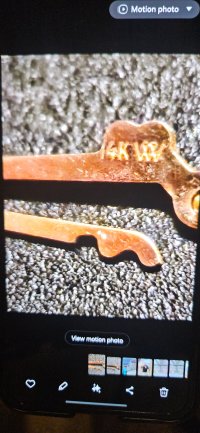
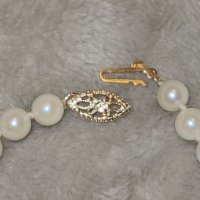
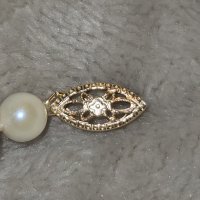
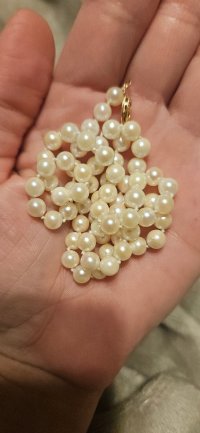
My husband bought me the ones on the left. 14k ww makers mark on gold clasp. Pawn shop said they're real. I believe they are, they're gritty, cold, heavy, etc. Anyway, it's incredibly special real or not. Upon research, I saw akoya...wondered if the ones on the right might be? I have a daughter who loves Japan and I think she would look beautiful in them. Although them being real would be a huge bonus. The photos are of mine. Other than the white necklace on the right. Should I go buy it?
20260205_155441.jpg
fy both!
 

Attachments

  • 20260205_202238.jpg
    20260205_202238.jpg
    1.2 MB · Views: 23
  • 20260205_201836.jpg
    20260205_201836.jpg
    676.9 KB · Views: 20
  • 20260205_201809.jpg
    20260205_201809.jpg
    696.7 KB · Views: 22
  • 20260205_202832.jpg
    20260205_202832.jpg
    1.1 MB · Views: 22
  • 20260205_202840.jpg
    20260205_202840.jpg
    1.1 MB · Views: 21
  • 20260205_202821.jpg
    20260205_202821.jpg
    1.2 MB · Views: 23
Yours are cultured akoya pearls. (Cultured pearls are real pearls.)
The ones on the right...I'm inclined to think they are cultured Chinese freshwater pearls, based on shapes. Would that be a deal breaker, if they were not Japanese akoyas?
 
No, not a deal breaker at all! I just believe she would feel it was more special if they were Japanese. Since they are much more white than mine I was thinking of getting them for her if they were real. I forgot to mention mine are about 5-6mm. Not all the same size. The white ones on the right I did not measure but they are larger and tight on the string. My string has knots in between each of them. I'm not sure if the price is too much or not? The ones from my husband, even if they weren't real, even if they costed too much, have a story behind them that makes it extremely sentimental for me so she can't have those.
The original pearls I had were real pearls handmade from a lady from church. We don't gamble but we had a free mother's Day raffle and I won them. I have five children and being a mother is the most special thing to me. My youngest tore them off of my neck as a baby and I put them away for safekeeping until they could be fixed one day. We moved a couple times and I haven't seen them in 6 years. So he bought me the new ones for Valentine's Day. If you don't mind sharing, is there a thread here or a website where I can learn more about these types of pearls from the experts? (I will look for myself I just want to make sure to go to the correct one). Or would you mind sharing how you know the identity and if you think I should get her the other ones? Thank you so much. I don't know a single person who knows anything about pearls including myself LOL from what I found it said they could be from the 1950s and are called a princess strand that was usually for a wedding or passed down.
 
Some terminology may help you.

Real pearls are either cultured (farmed pearls) or natural (wild pearls, rare and very expensive, created in nature by mollusks without any human intervention.)
The pearl market has been a cultured pearl market for the past century.

Imitation (fake) pearls are made in factories and never see an oyster! A bead (glass, plastic or sometimes shell) is dipped in a lacquer made with an extract from fish scales.

The pearls on the right appear to be knotted, real cultured pearls. The variation in the shapes and sizes makes it unlikely they are imitations.
They could be lower quality akoyas, some off round, with relatively thin nacre, which produces a milky white appearance. Akoyas are much more costly than freshwaters, and good quality akoyas would cost much more than $149.99. While vintage akoyas could cost less than recent ones, vintage akoyas are more likely to be a cream color than white. Good akoyas would have better luster than that strand also.

I think they look more like freshwater pearls, which generally have lower luster than akoyas. On the plus side, if they are freshwaters, they would be solid nacre and very durable, whereas akoyas with thin nacre would be more fragile.

Additionally, some akoyas were produced in China. Not so much today any more, but if these pearls are from 10-20 years ago, they may have originated in China. I'm just telling you that since it seems a Japanese origin seems significant given your daughter's tastes.

A simple test you can do to assure yourself they are real is to rub two of the pearls together gently. (Please don't rub them against your tooth. Teeth are harder than nacre and can scratch the pearls.) What do you feel? Real pearls feel a bit gritty when rubbed together while fake pearls feel smooth. (This test can be thrown off if real pearls are coated or if fake pearls are dirty).

If the store has a jeweler's loupe you can borrow, use it to look at the surface of the pearls. Fake pearls have a grainier surface appearance than real pearls. This photo of Renee Newman's shows a fake pearl (top) and a real one (bottom) under 10x magnification.

Renee Newman's photo of imitation (top) and cultured (bottom) pearls at 10x magnification.jpg


Renee Newman wrote a book called Pearl Buying Guide that is now out of print but can be found at many libraries. Perhaps your library has a copy. There were 6 editions, the last one in 2017.

She has also written a new book that was just published this fall, which I highly recommend. Details:

Finally if you would like to take the CPAA course "Pearls as One" you will learn a great deal about pearls! It is loaded with photos and videos and
the question and answer section below each chapter is very informative. It is also being continually updated. This is the website, and I will message you a code to take the course for free.

 
Back
Top