Welcome to the forum!
During the 1940s and 50s, graduated strands of cultured akoya pearls were sold in large numbers in Japan, often to servicemen, who bought them for their ladies at home. Typically the end pearls were about 3mm and the center pearl about 7mm. They were called 3.5 momme strands (momme being a unit of weight-- pearls are sold by weight) and were relatively affordable since most of the pearls were smaller. Here is a page that has some more information about these strands:
http://www.imperial-deltah.com/news2/pearls_and_occupied_japan.htm
Edit: The above link no longer leads anywhere but I happened to save what it said:
"In 1948, The Allied Occupation Forces liberalized the trade of cultured pearls, reopening the door to both the domestic and international markets. Between 1948 and the early 1960s, Japan’s Akoya industry was still living almost entirely off the pro*duction and export of “3.5 momme graduation necklaces?’ The most popular “graduations", delivered by the thousands, had a wholesale price of $7.00 per strand, the equivalent of ~2,520 [Yen] at that time. Higher quality necklaces which were also very pop*ular fetched $10.00 to $20.00 (Y3,600 to ~7,200).
For comparison, a Japanese male university graduate hired by a Japanese company in 1953 would receive a starting salary of approximately ~4,500 a month. (The large trading houses, however, such as Mitsui or Sumitomo might pay as much as ~6,000.)"
I think that is probably what you have, but I've also seen fake graduated strands. To be sure they are real, you can rub 2 of the pearls near the clasp against each other (gently!) and see if they are gritty. Fake pearls are smooth when rubbed together. It would be interesting to check the clasp also for a metal hallmark (could say 925 for sterling silver, or 14K for white gold.)
These older pearls had thicker nacre than the average akoya strand today as the farmers left the pearls in the water longer. That is great news as it means they are durable.
I've found these strands clean up very nicely and look great when restrung. You can clean them with mild soapy water and a soft cloth. I have a restringing tutorial that is stickied on the Lowly Beaders Club forum. I found 10# PowerPro to be a good size thread for stringing the 2 strands I have that are like yours. Edit: These days I use Fine (#40) size Serafil thread to string such strands. Ivory is a good color for these vintage strands.
I expect the ring is also cultured akoya pearls, which are very round due to their having a bead as a nucleus.

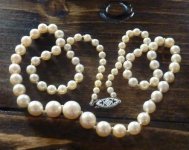
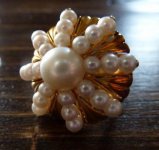
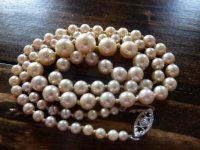
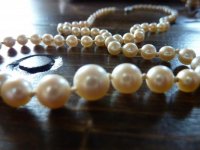

 The clasp does have a marking, but my eyes can't read it. Any idea of the value of such pearls? I think the ring says 18k gold on the inside of the band. I should probably get a magnify glass.

