Antique imitation pearls

MrGray

Well-known member
Joined
Oct 12, 2024
Messages
38
Location
Serbia
Hello to everyone!
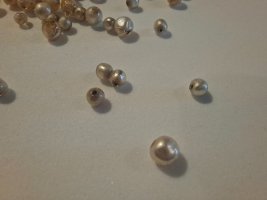
I just came in a possesion of two about 100 years old short pearl necklaces for which I knew they are imitations (one has very nice 935 antique silver clasp with a white topaz, and that was the reason I bought them).
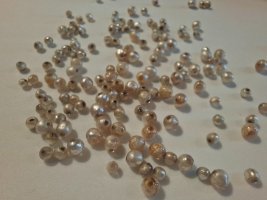
By cleaning them, I saw that the paint does not come off, but I also noted fragments of a jelly material for which, at first, I thought was a dirt.
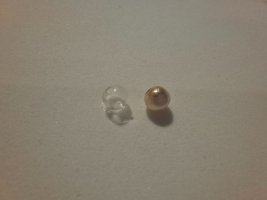
Later, after drying them, I noticed one clear glass bead and I realised they are all made of very tiny and thin clear glass that is filled with pearlescent material.
I have never seen something like that before.
On the internet I found that it is very old technique when glass beads were filled with essence d'orient (made of a fish scales) and wax, and now I am very interested to hear more about it :)
I included pictures, on the last is shown an empty glass bead..
 

Attachments
  • 20260505_192600.jpg
    20260505_192600.jpg
    561.3 KB · Views: 26
  • 20260505_192620.jpg
    20260505_192620.jpg
    498.1 KB · Views: 20
  • 20260505_192735.jpg
    20260505_192735.jpg
    456.2 KB · Views: 21
Last edited:
The first image reminds me of Murano glass. I hope cleaning didn't harm them too much?
 
CoPilot says:
Glass Beads Filled with Essence d’Orient

Glass beads filled with essence d’orient were a type of wax-filled imitation pearl developed in 17th‑century France as a safer, mercury‑free alternative to earlier methods of creating pearl‑like beads journals.uoregon.edu+1.

Historical origin

Before 1686, French beadmakers often used mercury to give hollow clear glass beads a pearl‑like luster. However, mercury was toxic, posing health risks to both makers and wearers journals.uoregon.edu. In that year, Jacquin, a glass merchant, was prompted by his daughter‑in‑law’s request for a necklace of false pearls to invent a new method. He discovered that mixing ammonia with the scales of the bleak (a European freshwater fish) produced a paste that mimicked the luster of pearls journals.uoregon.edu. This paste became known as essence d’orient.

Production process
  • Hollow glass beads were blown and left with an internal cavity.
  • The inside surface was coated with essence d’orient to give a pearlescent, nacreous appearance journals.uoregon.edu+1.
  • The beads were then filled with wax to add weight and a smooth, pearl‑like feel Wikipedia.
  • The coating could be applied multiple times (up to 10 coats) to enhance the iridescence Springer.
Variations and names

These beads were also called:
  • Parisian pearls
  • French pearls
  • Bourguignon pearls
  • Venetian pearls (solid glass beads sprayed with essence d’orient) Wikipedia+1.
Cultural and commercial use
  • In the 19th and early 20th centuries, wax‑filled glass beads became popular in costume jewelry, especially worn by stage performers and fashionable women journals.uoregon.edu+1.
  • They were valued for their affordability and elegant appearance, making them accessible to a wider market than real pearls journals.uoregon.edu.
  • By the 1920s–1930s, imitation pearls like these were a staple in Parisian and Roman beadmaking industries Academia.edu.
Distinction from other faux pearls

Unlike mother‑of‑pearl or plastic‑coated beads, essence d’orient beads were glass cores with a pearlescent coating and wax filling, giving them a smooth, non‑gritty surface that differed from natural pearls Wikipedia+1.

In short, glass beads filled with essence d’orient were a hallmark of French beadmaking innovation, replacing toxic mercury with a fish‑scale‑based paste to create affordable, elegant, and safe faux pearls.
 
Thank you for your very studious answer!
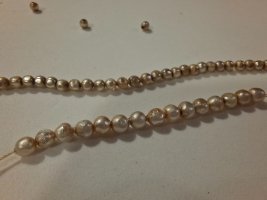
They do not look different then before washing, you can see when i restringed them.
They are in two sizes, one slightly larger than another...
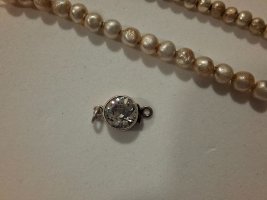
And you can see the clasp that was the reason I bought them, it is made from 935 silver which was used in Germany and Austria in the 1920. period. That is how I assume they are about a hundred years old.
I think it is so simple and elegant, with that vintage setting, with a white topaz which is confirmed on my gem identifier.
 

Attachments

  • 20260505_224807.jpg
    20260505_224807.jpg
    525.5 KB · Views: 13
  • 20260505_224953.jpg
    20260505_224953.jpg
    555.6 KB · Views: 14
It's one of the best AI responses I've seen. :giggle:
I think your faux pearls are a very cool find -- even if you only wanted the clasp.
 
Back
Top