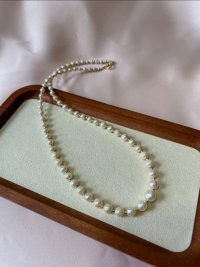
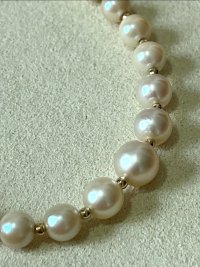
Are these Akoya pearls?

Joined
Apr 10, 2026
Messages
5
I am purchasing this strand from an online thrift store that claims it's Akoya pearls. The size is from 3 to 8mm. From the looks of it, is it really saltwater pearls? Price is quite cheap!

Hope to get some opinions on this and thank you in advance 🙂
 

Attachments

  • Screenshot_20260427_154333_Instagram.jpg
    Screenshot_20260427_154333_Instagram.jpg
    261.6 KB · Views: 19
  • Screenshot_20260427_154319_Instagram.jpg
    Screenshot_20260427_154319_Instagram.jpg
    258.9 KB · Views: 18
Real pearl nacre should feel a bit gritty when pearls are gently rubbed against each other (don't rub hard enough to make dust)! But sometimes people mistake what they are feeling. Fake pearls can feel a bit resistant when rubbed together if they are grimy.

In any case you won't get the chance to rub them until after you have bought them, so, unless they are returnable, I don't recommend buying them (unless they are so cheap that you don't care about the money or would enjoy them even if they are fake).

Akoya pearls are not usually strung with gold colored beads between them.
The appearance of the luster and the uniformity of the luster and color also make me think they are fake.
 
The rub two pearls together test, and the rub pearls on your teeth test, NEVER work for me, and I've handled lots of real and fake pearls. I can tell better by looking at the pearls themselves and also how they were strung.

These look like imitations to me. The surface color and texture look like imitation pearls. Real pearls would not be strung with gold seed beads as they turn real pearls black. If these were solid 18K gold beads, then real pearls would not discolor, but then the necklace would not be cheap because real gold is sky high in price right now. Plus, there's a cheap spring ring clasp.

An online thrift store is not a certified jeweler. They're probably using the words "akoya pearls" generically for these beads, instead of "these are real cultured akoya pearls."

 
The rub two pearls together test, and the rub pearls on your teeth test, NEVER work for me, and I've handled lots of real and fake pearls. I can tell better by looking at the pearls themselves and also how they were strung.

These look like imitations to me. The surface color and texture look like imitation pearls. Real pearls would not be strung with gold seed beads as they turn real pearls black. If these were solid 18K gold beads, then real pearls would not discolor, but then the necklace would not be cheap because real gold is sky high in price right now. Plus, there's a cheap spring ring clasp.

An online thrift store is not a certified jeweler. They're probably using the words "akoya pearls" generically for these beads, instead of "these are real cultured akoya pearls."
Just curious as learning about pearls turns out to be so interesting for me, why did the tests never worked for you? Are there fakes that can give the same results as real pearls with this test?
 
I have personally never found imitation pearls to feel like real pearls when rubbed together, not even the very high end Majorica brand imitation pearls.

Imitation pearls made with glass or plastic beads are also warmer than real pearls. The temperature difference can be felt when they are held briefly to one's lips. For this test they have to have been kept at the same ambient temperature for a while before the test, to eliminate that variable.

One can also see a difference in the surface appearance of real pearls and imitation ones when viewed with a 10x jeweler's loupe. Real nacre looks smooth; imitation pearly coating has a somewhat coarser appearance-- even the best imitation pearls. (This test can fail if real pearls have been coated to improve the surface shine of mediocre pearls).
 
Just curious as learning about pearls turns out to be so interesting for me, why did the tests never worked for you? Are there fakes that can give the same results as real pearls with this test?

I cannot feel the difference, but I don't have much feeling in my fingertips, so that might be why. You have to have just the right amount of pressure. A person doing it for the first time doesn't have the experience to understand how much or little pressure, and what real pearls feel like, to be able to know the difference. I've have heard of people rubbing so hard that they grind dust off the pearls. That's not what you're supposed to be doing. You are just gently rubbing them to see if the surface feels gritty or smooth, but the difference is very subtle.

For me, my eyes can tell better than rubbing them together or rubbing them on my teeth.
 
Back
Top