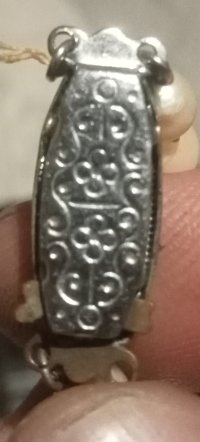
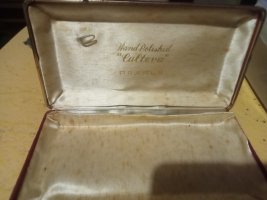
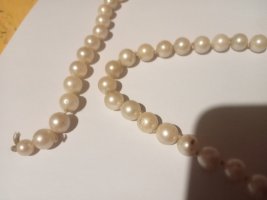
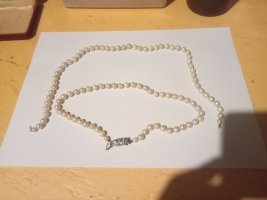
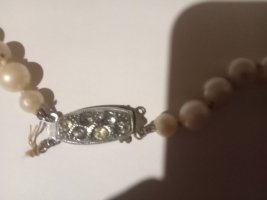
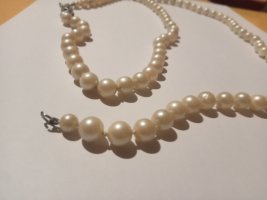
Was wondering if these look real before I take them for proper testing

You are using an out of date browser. It may not display this or other websites correctly.
You should upgrade or use an alternative browser.
You should upgrade or use an alternative browser.
Found pearls that belonged to great grandmother do they look real Ty in advance
- Thread starter rapid707
- Start date

Pearl Dreams
Pearl Enthusiast
To me they look like imitation pearls. See those smaller pearls right at the ends where the clasp connects? That is a common thing with imitation strands.
The photos are out of focus but the pearls all look the same. Typical of fake pearls.
Imitation pearls were very common with the older generations of ladies. My late mother and late MIL loved their imitation strands (but they thought they were real).
The photos are out of focus but the pearls all look the same. Typical of fake pearls.
Imitation pearls were very common with the older generations of ladies. My late mother and late MIL loved their imitation strands (but they thought they were real).
Ty I thought that was the case being all perfectly roundTo me they look like imitation pearls. See those smaller pearls right at the ends where the clasp connects? That is a common thing with imitation strands.
The photos are out of focus but the pearls all look the same. Typical of fake pearls.
Imitation pearls were very common with the older generations of ladies. My late mother and late MIL loved their imitation strands (but they thought they were real).
Pearl Dreams
Pearl Enthusiast
It isn't just being round, as real akoya pearls are usually round. But all being the same size-- in a real strand there is usually up to 0.5mm difference between the smallest and largest in a strand. e.g. a strand may be sold as 6.5-7.0mm. This is because real pearls are made by living mollusks and are not a calibrated size.
Also in a real strand you should see some small variations in the pearls-- in overtone colors, in luster, in small blemishes.
And the clasp seems to be base metal with rhinestones.
Also in a real strand you should see some small variations in the pearls-- in overtone colors, in luster, in small blemishes.
And the clasp seems to be base metal with rhinestones.
Thank you for for correcting my understanding of pearls.Good to know for if I ever encounter any jewellery with pearlsIt isn't just being round, as real akoya pearls are usually round. But all being the same size-- in a real strand there is usually up to 0.5mm difference between the smallest and largest in a strand. e.g. a strand may be sold as 6.5-7.0mm. This is because real pearls are made by living mollusks and are not a calibrated size.
Also in a real strand you should see some small variations in the pearls-- in overtone colors, in luster, in small blemishes.
And the clasp seems to be base metal with rhinestones.
Pearl Dreams
Pearl Enthusiast
There are other ways to tell real pearls from fake ones. I could elaborate if you are interested.
I am interested only if you would like to take the extra time to educate me or you could suggest a page for me to readThere are other ways to tell real pearls from fake ones. I could elaborate if you are interested.
Pearl Dreams
Pearl Enthusiast
I have a little time now. 
First, these are not definite ways to tell if pearls are fake:
You can't tell by the knotting. Either real or fake pearls may be knotted between every pearl or only knotted between the end few pearls.
You can't tell by whether the strands are finished with French wire at the clasp (a better quality technique) or with bead tips.
You can't tell by weight (unless the pearls are plastic and very lightweight.) Glass pearls weigh much the same as real ones.
You can't tell by the metal of the clasp. While fake pearls don't usually have karat gold clasps, I actually have 3 pieces that have 750 (18K) clasps. Also clasps can be changed when pearls are restrung. Real vintage pearls often had silver clasps and many fake strands do too.
You can't tell by the box they come in. I have seen fake plastic pearls in a box that had a label stating "cultured pearls." Any pearls can be placed in any box.
In my next post...some qualities fake pearls may have.
First, these are not definite ways to tell if pearls are fake:
You can't tell by the knotting. Either real or fake pearls may be knotted between every pearl or only knotted between the end few pearls.
You can't tell by whether the strands are finished with French wire at the clasp (a better quality technique) or with bead tips.
You can't tell by weight (unless the pearls are plastic and very lightweight.) Glass pearls weigh much the same as real ones.
You can't tell by the metal of the clasp. While fake pearls don't usually have karat gold clasps, I actually have 3 pieces that have 750 (18K) clasps. Also clasps can be changed when pearls are restrung. Real vintage pearls often had silver clasps and many fake strands do too.
You can't tell by the box they come in. I have seen fake plastic pearls in a box that had a label stating "cultured pearls." Any pearls can be placed in any box.
In my next post...some qualities fake pearls may have.
Wow they are sneaky they do the same with gold and silver aswellI have a little time now.
First, these are not definite ways to tell if pearls are fake:
You can't tell by the knotting. Either real or fake pearls may be knotted between every pearl or only knotted between the end few pearls.
You can't tell by whether the strands are finished with French wire at the clasp (a better quality technique) or with bead tips.
You can't tell by weight (unless the pearls are plastic and very lightweight.) Glass pearls weigh much the same as real ones.
You can't tell by the metal of the clasp. While fake pearls don't usually have karat gold clasps, I actually have 3 pieces that have 750 (18K) clasps. Also clasps can be changed when pearls are restrung. Real vintage pearls often had silver clasps and many fake strands do too.
You can't tell by the box they come in. I have seen fake plastic pearls in a box that had a label stating "culutured pearls." Any pearls can be placed in any box.
In my next post...some qualities fake pearls may have.
Pearl Dreams
Pearl Enthusiast
Lower quality fake pearls may have these (but not better fake pearls):
• Swirls of excess pearlescent coating near the drill holes
• Large drill holes (pearl are sold by weight so the holes tend to be drilled small to preserve weight.) If the knots seem too large it may be because they had to use thicker thread -- which makes larger knots-- to compensate for the larger holes.
• Beveled (angled) shape near the drill holes
• Flaked off coating either near drill holes, or on other parts of the pearl, with the bead showing underneath
• Swirls of excess pearlescent coating near the drill holes
• Large drill holes (pearl are sold by weight so the holes tend to be drilled small to preserve weight.) If the knots seem too large it may be because they had to use thicker thread -- which makes larger knots-- to compensate for the larger holes.
• Beveled (angled) shape near the drill holes
• Flaked off coating either near drill holes, or on other parts of the pearl, with the bead showing underneath
Very interesting information thank you if I ever deal with pearls I'll come back to this thread much appreciated all the bestLower quality fake pearls may have these (but not better fake pearls):
• Swirls of excess pearlescent coating near the drill holes
• Large drill holes (pearl are sold by weight so the holes tend to be drilled small to preserve weight.) If the knots seem too large it may be because they had to use thicker thread -- which makes larger knots-- to compensate for the larger holes.
• Beveled (angled) shape near the drill holes
• Flaked off coating either near drill holes, or on other parts of the pearl, with the bead showing underneath
Pearl Dreams
Pearl Enthusiast
Here are a few tests you can do:
1. Temperature test. Real pearls are cooler than fake ones. This test works for plastic and glass pearls; I have not yet tried it with imitation pearls that have a shell bead, as these are less common and I don't have any. I may buy some just to try the test on them.
To do this test, you will need some "control" pearls for comparison. The control pearls can be either pearls you know are real or pearls you know are fake. Place the pearls to be tested in the same room -- the same temperature environment-- as the control pearls for half an hour or so. Then touch them to your lips briefly. Repeat with the other pearls. What do you feel? Lips are very good as sensing temperature differences.
2. Rubbing test: Don't rub pearls on teeth; teeth are harder and can scratch the pearls. Instead, rub one against another. Real pearls feel a bit gritty while fake pearls don't. They may glide smoothly or they may feel a bit gummy, if they are not clean. Don't rub too hard.
3. Loupe test: Under 10x magnification, real pearls look very smooth while fake ones are a bit more coarse looking. I found this photo of Renee Newman's to illustrate
(fake pearl on top)

1. Temperature test. Real pearls are cooler than fake ones. This test works for plastic and glass pearls; I have not yet tried it with imitation pearls that have a shell bead, as these are less common and I don't have any. I may buy some just to try the test on them.
To do this test, you will need some "control" pearls for comparison. The control pearls can be either pearls you know are real or pearls you know are fake. Place the pearls to be tested in the same room -- the same temperature environment-- as the control pearls for half an hour or so. Then touch them to your lips briefly. Repeat with the other pearls. What do you feel? Lips are very good as sensing temperature differences.
2. Rubbing test: Don't rub pearls on teeth; teeth are harder and can scratch the pearls. Instead, rub one against another. Real pearls feel a bit gritty while fake pearls don't. They may glide smoothly or they may feel a bit gummy, if they are not clean. Don't rub too hard.
3. Loupe test: Under 10x magnification, real pearls look very smooth while fake ones are a bit more coarse looking. I found this photo of Renee Newman's to illustrate
(fake pearl on top)
Last edited:
Pearl Dreams
Pearl Enthusiast
And then there is the overall impression of a strand. Too uniform = probably fake.
A real pearl strand, even a very good one, will have some blemishes, no matter how small. Maybe a few pinpricks. But a fake strand may look perfect.
If there are overtone colors, they will not all be the same from pearl to pearl. I have some very good quality fakes-- the best-- Majorica. They have a final coating that imitates the iridescence of real good quality akoyas. But every pearl looks the same. In a real akoya strand that would not be the case.
You may find this thread interesting-- lots of photos of fake pearls:
A real pearl strand, even a very good one, will have some blemishes, no matter how small. Maybe a few pinpricks. But a fake strand may look perfect.
If there are overtone colors, they will not all be the same from pearl to pearl. I have some very good quality fakes-- the best-- Majorica. They have a final coating that imitates the iridescence of real good quality akoyas. But every pearl looks the same. In a real akoya strand that would not be the case.
You may find this thread interesting-- lots of photos of fake pearls:

Some of us want a place to share photos and stories of various man-made pearl-lookalikes, so let's put them here. This can be helpful for comparison and educational purposes, examples of jewelry, vintage or new, which are not cultured or natural pearls. I'll be taking some photos soon!
- pattye
- Replies: 216
- Forum: Identify my Pearls!

Pearl Dreams
Pearl Enthusiast

I like the info about the rubbing test Google told me to try tooth test that did not make sense to me that's han
Wow near perfectAnd then there is the overall impression of a strand. Too uniform = probably fake.
A real pearl strand, even a very good one, will have some blemishes, no matter how small. Maybe a few pinpricks. But a fake strand may look perfect.
If there are overtone colors, they will not all be the same from pearl to pearl. I have some very good quality fakes-- the best-- Majorica. They have a final coating that imitates the iridescence of real good quality akoyas. But every pearl looks the same. In a real akoya strand that would not be the case.
You may find this thread interesting-- lots of photos of fake pearls:
Some of us want a place to share photos and stories of various man-made pearl-lookalikes, so let's put them here. This can be helpful for comparison and educational purposes, examples of jewelry, vintage or new, which are not cultured or natural pearls. I'll be taking some photos soon!
- pattye
- Replies: 216
- Forum: Identify my Pearls!
Pearl Dreams
Pearl Enthusiast
Many famous ladies have worn imitation pearls!
Jackie Kennedy's famous 3 strand necklace were fakes made by Kenneth Jay Lane. As were First Lady Barbara Bush's pearls.
Coco Chanel wore fake pearls.
Kate Middleton had some nice fake pearl earrings.
I understand Diana also had some fakes.
Jackie Kennedy's famous 3 strand necklace were fakes made by Kenneth Jay Lane. As were First Lady Barbara Bush's pearls.
Coco Chanel wore fake pearls.
Kate Middleton had some nice fake pearl earrings.
I understand Diana also had some fakes.
Pearl Dreams
Pearl Enthusiast
Well, I have rambled long enough. 
Many famous ladies have worn imitation pearls!
Jackie Kennedy's famous 3 strand necklace were fakes made by Kenneth Jay Lane. As were First Lady Barbara Bush's pearls.
Coco Chanel wore fake pearls.
Kate Middleton had some nice fake pearl earrings.
I understand Diana also had some fakes
Haha don't worry I do the same to friends and family but with coins and silver it was a very interesting conversationWell, I have rambled long enough.
I might have one more question about pearls from a investment perspective Ive been looking at assets to invest in for appreciation in value over time I'm 30 now I plan on holding till I retire is it a sound choice to maybe accuire some pearls from your experience have they appreciated over time Ty kindlyHaha don't worry I do the same to friends and family but with coins and silver it was a very interesting conversation
Similar threads
- Replies
- 20
- Views
- 2K


